

Profit and Loss Statement Explained (P&L)
Learn what a profit and loss statement shows, how to read the figures and how to use one to understand your business performance.
A profit and loss statement shows whether your business is making money. It brings together your income and expenses for a set period, so you can see your revenue, costs and final profit or loss.
Limited companies use profit and loss figures as part of their annual accounts, while sole traders and self-employed people need their income and expense totals for Self Assessment. Reviewing a P&L regularly can also help you spot rising costs, compare performance and make better business decisions.
This guide explains what a profit and loss statement includes, how to read the figures and how to prepare one. You’ll also find a worked example and a free Excel profit and loss template.
Disclosure: This content may contain affiliate links, which means if you click on them, I may get a commission (without any extra cost to you).
Profit and Loss Statement At a Glance
- Also called an income statement or P&L
- Shows total sales and total expenses over a set time
- Limited companies include it in their annual accounts
- Sole traders use the figures for Self Assessment
- Basic formula: Income − Expenses = Profit or Loss
- Can be prepared using Excel or accounting software
A profit and loss statement can cover a month, quarter or full year. It helps you see whether the business is profitable and how income and costs change over time.
You may review it monthly or quarterly for management purposes, while annual figures are used for accounts and tax reporting.
Prefer to automate your Profit and Loss reporting?
Accounting software can produce an up-to-date P&L automatically from your bookkeeping records.
Who needs a Profit and Loss Statement?
Limited companies must prepare a profit and loss statement as part of their annual accounts. Small companies and micro-entities can currently omit it from the accounts they file at Companies House, although this changes from April 2028.
Sole traders, landlords and the self-employed are not required to submit a formal P&L to HMRC, but they do need the income and expense totals to complete their Self Assessment return and work out tax liability.
Partnerships use the statement to work out each partner’s share of the profit.
The Other Financial Statements
The P&L statement is one of three main financial reports. Each one tells you something different about your business.
The Balance Sheet shows the company’s financial health at a single point in time: what the business owns (assets), what it owes (liabilities), and what is left over for the owner (equity). Where the P&L statement covers a period of time, the balance sheet is a snapshot of a single day, usually the last day of your financial year.
The Cash Flow Statement shows how cash has moved in and out of the business during a set period. It helps explain changes in cash by separating operating, investing and financing activities. A business can report a profit but still have cash flow problems, so the cash flow statement gives a different view from the Profit and Loss Statement.
Together, these three reports show different parts of your financial position: the Profit and Loss Statement shows whether the business made a profit, the Balance Sheet shows what it owns and owes, and the Cash Flow Statement shows how cash moved in and out during the period.

The Profit and Loss Statement Basic Formula
Every profit and loss statement is built on the same simple idea:
Sales – Expenses = Total Profit (or Loss)
Profit and Loss Statement Terms Explained
Before working through an example, it helps to understand the main terms you will come across.
Sales (or Turnover) is the total amount of sales during the period covered. If you offer multiple revenue streams, they may be listed separately before the total.
Cost of Goods Sold, or Cost of Sales COS is the cost of producing whatever you sold. For a product business, this means the cost of buying or making the goods. For a service business, it might include direct labour. It only covers what is directly tied to sales, not general running expenses. For example, if you bought £5,000 of stock in a month but only used £3,000 of it to fulfil sales, the COS is £3,000 — not £5,000.
Gross Profit is what is left after deducting the cost of goods sold from total income.
Gross Profit = Sales – Cost of Sales
Operating Expenses (or Overheads or operating costs) are the general expenses that are not directly tied to a specific sale. These include:
- Wages and salaries
- Rent and rates
- Utilities
- Insurance
- Marketing and advertising
- Telephone and broadband
- Accountancy and professional fees
- Stationery and office supplies
- Depreciation of fixed assets
- Bank charges
Operating Profit is gross profit minus overheads. It shows how profitable the core operations are before interest and tax.
Net Profit or net Income is the final bottom line, what the business has actually earned after all expenses, including interest and tax, have been deducted.
Net Profit = Gross Profit – operating expenses – Interest – Tax
How to Read a Profit and Loss Statement
Reading a profit and Loss statement is easier than it looks. It runs from top to bottom. You start with sales, then work down through the expenses until you reach the final profit or loss.
Step 1 – Start with sales. Check total revenue for the period. If you have more than one product or service, compare which areas are performing best.
Step 2 – Check cost of sales. These are the direct costs of producing or delivering what you sell, such as materials, stock or direct labour.
Step 3 – Check gross profit. Gross profit is sales less cost of sales. Compare it with previous periods to see whether margins are improving or falling.
Step 4 – Review overheads. Look at running costs such as rent, insurance, utilities and professional fees. Check whether any expenses have increased unexpectedly.
Step 5 – Look at net profit. This is the final result after all expenses. Compare it with previous months, quarters or years.
Step 6 – Compare periods. Looking at several P&L statements side by side can help you spot trends in sales, costs and profit.
Reading your P&L regularly makes it easier to spot changes early and understand what is driving your profit or loss.
How to Prepare a Profit and Loss Statement
To prepare a profit and loss statement, choose the period you want to report on and total your sales or other business income. Next, deduct the cost of sales to calculate gross profit, then list and deduct your overheads and other expenses to arrive at the net profit or loss.
You can prepare a P&L manually in Excel or use accounting software to create the report automatically from your bookkeeping records. Whichever method you use, make sure you include all income and expenses for the period and record them consistently.
Gross Profit vs Net Profit
Gross profit and net profit show different stages of profitability.
Gross profit is what remains after deducting the cost of sales from your revenue. It shows how profitable your core trading activity is before you account for general running costs.
Net profit is what remains after deducting overheads and other expenses. It shows the overall profit made by the business for the period.
Gross profit margin shows gross profit as a percentage of sales:
Gross Profit Margin = (Gross Profit ÷ Sales) × 100
Net profit margin shows net profit as a percentage of sales:
Net Profit Margin = (Net Profit ÷ Sales) × 100
Use our net profit margin calculator to work out your own figures.
Cash Basis vs Accruals
Cash Basis vs Accrual Accounting
The accounting method you use affects when income and expenses are recorded, so it can change the profit shown for a particular period.
Accrual accounting records income when it is earned and expenses when they are incurred, even if you have not yet received or paid the money. This means unpaid customer invoices and supplier bills can still appear in the accounts for that period. It gives a fuller picture of the business activity during the period.
Cash basis accounting records income when you receive the money and expenses when you pay them. It is simpler because transactions are based mainly on money moving in and out of the business.
For most sole traders, cash basis is now the default method for calculating taxable profits, although they can choose to use accrual accounting instead. Limited companies must use accrual accounting when preparing their statutory accounts.
The key point is knowing which method your accounts use. A business can show different profit figures for the same period under cash basis and accrual accounting simply because income and expenses are recorded at different times.
Example Accounting Profit and Loss Statement
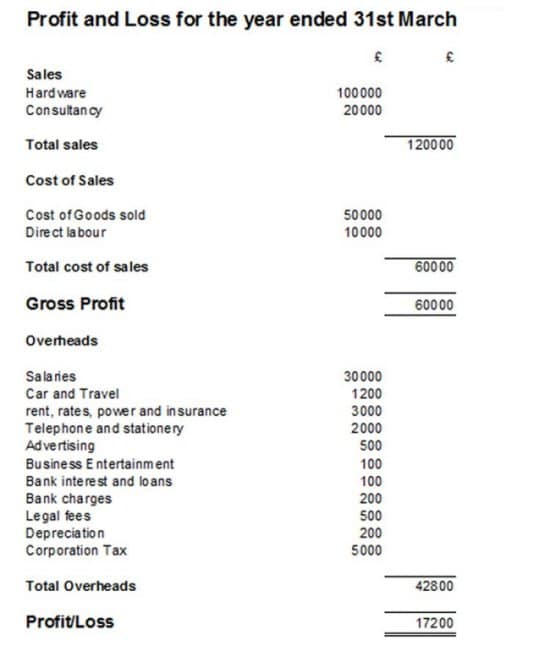
Below is an example Profit and Loss account in the UK for a year.
Profit and Loss Calculation
Using the above P&L example, we can make the following calculations:
- Turnover or total revenue – the total of hardware and consultancy of 120,000
- Cost of Goods Sold – includes hardware and direct labour of 60,000
- Gross Profit – Sales 120,000 less cost of goods sold 60,000, giving a total of 60,000
- Overheads of 42,800 are deducted to leave a profit of 17,200
Using Accounting Software
Bookkeeping software like Sage UK, Xero or QuickBooks can create a profit and loss statement automatically from your bookkeeping records.
As you record sales, purchases and expenses, the software updates the report for you. You can usually run a P&L for any date range, making it easy to compare months, quarters or years.
Keeping your bookkeeping up to date means you can check profitability throughout the year, rather than waiting until year-end. It also gives your accountant more complete records and reduces the risk of missing transactions or receipts.

Simple Profit and Loss Statement Template UK
We offer a free Excel profit and loss template for sole traders, landlords, charities and personal use. It covers a full year with monthly columns and includes five income categories and fifteen expense categories, which you can rename to suit your business.
For sole traders who need to keep digital records for Making Tax Digital for Income Tax, we also have an MTD ITSA spreadsheet version designed around the tax year and quarterly reporting periods.
Both templates are easy to set up and include full instructions on their download pages.

Profit and Loss Statement FAQ
Do all businesses need a Profit and Loss Statement?
Limited companies must prepare a profit and loss account as part of their annual accounts. Sole traders and self-employed people do not have to prepare a formal P&L for HMRC, but they do need accurate income and expense figures for their Self Assessment tax return.
What is the difference between a P&L and a Balance Sheet?
The P&L covers income and spending over time and shows whether you made a profit or a loss. The balance sheet shows the financial position at a single point in time: what the business owns, what it owes, and the owner’s equity.
What is the difference between gross profit and net profit?
Gross profit is sales minus the direct cost of goods or services. Net profit is what remains after deducting all costs, including overheads, interest, and tax. A business can have a strong gross profit and still make a net loss if its overheads are too high.
How often should I produce a Profit and Loss Statement?
At a minimum, once a year for your accounts and tax return. Most owners benefit from doing this monthly or quarterly to spot trends and make decisions before problems get bigger.
Profit and Loss Conclusion
A profit and loss statement shows whether your business has made a profit or a loss over a given time. It is a legal requirement for limited companies and provides the figures sole traders need for their Self Assessment tax return. Reviewing it regularly helps you understand your income, monitor spending, and make better decisions about where the business is headed.
Related Pages
Free Profit and Loss Template
Balance Sheet: Guide and free template
Cash Flow Forecast: Guide and free template
Net Profit Margin Calculator
Cost of Sales
Self-Employed Bookkeeping
Best Accounting Software for Small Businesses
Break-Even Point
